

Is a Toradol Shot for Pain Right for You? Professional Care in Columbia, MD
Deciding on the best treatment for severe, acute pain requires a personalized approach and medical insight. At the Nasseri Clinic of Arthritic & Rheumatic Diseases in Columbia, MD, Dr. Nasser Nasseri, MD and his dedicated team are here to help you determine if a Toradol shot is the right solution for your specific needs. As a potent, non-narcotic anti-inflammatory medication, Toradol is highly effective for the short-term management of intense pain flare-ups, but it requires professional oversight to ensure it aligns with your overall health. For more information, contact us or book an appointment online. We are conveniently located at 5500 Knoll North Dr, Suite 250B, Columbia, MD 21045.
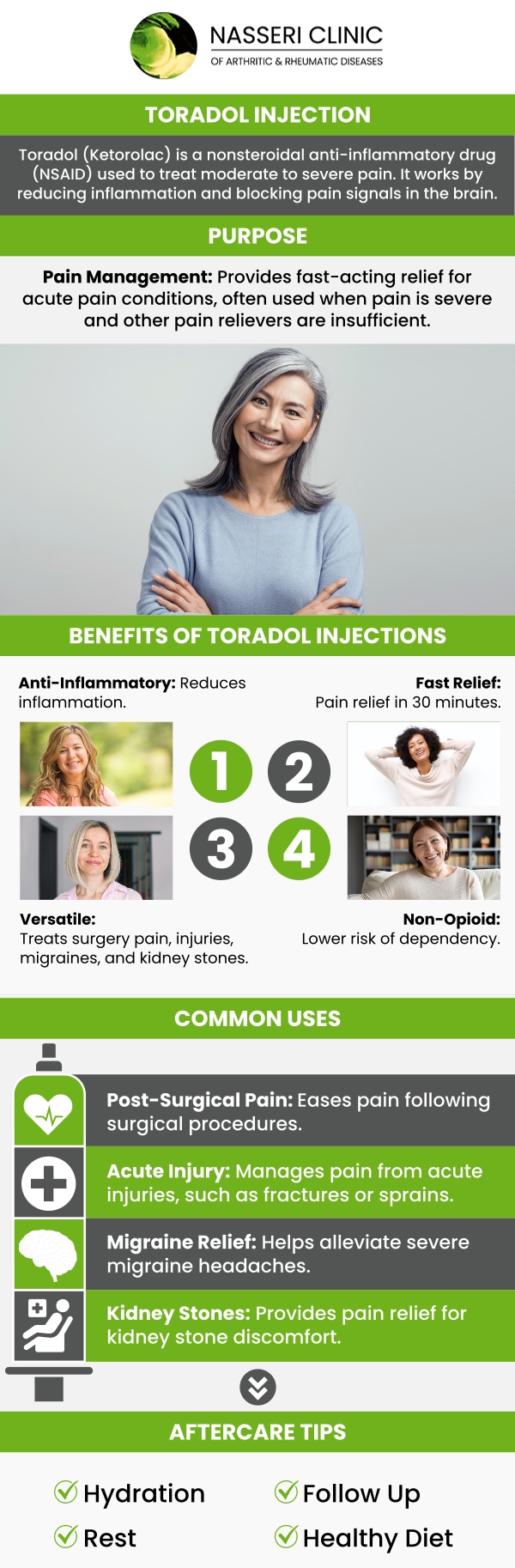
Table of Contents:
Who may be a good candidate for a Toradol shot for pain?
When might a Toradol shot be considered instead of an oral pain reliever?
What medical conditions may make a Toradol shot unsuitable?
What can patients expect when receiving a Toradol shot for pain?
How does Dr. Nasser Nasseri, MD, evaluate whether a Toradol shot for pain is right for a patient?
At Nasseri Clinic of Arthritic and Rheumatic Diseases, our team specializes in managing pain related to arthritis, autoimmune conditions, and other rheumatic diseases. For some patients experiencing moderate to severe short-term pain, especially when related to inflammation, a Toradol (ketorolac) injection may be considered as part of your treatment plan.
A Toradol shot is most commonly considered for adults who are experiencing acute pain due to flare-ups of inflammatory arthritis, musculoskeletal injuries, or after certain procedures performed in our clinic. This medication is a nonsteroidal anti-inflammatory drug (NSAID), making it particularly effective for pain caused by inflammation—a frequent concern for patients with rheumatic and arthritic conditions.
Toradol injections can be helpful when:
• Oral pain medications (like other NSAIDs or acetaminophen) have not provided enough relief
• Patients are unable to take medications by mouth due to gastrointestinal upset, difficulty swallowing, or nausea
• Quick pain relief is needed to improve function and quality of life
Not all patients are candidates for Toradol. It is not recommended for those with:
• Significant kidney problems
• A history of stomach ulcers or gastrointestinal bleeding
• Allergies to NSAIDs
• Bleeding disorders or those on blood thinners
• Severe liver or heart disease
• Women who are pregnant (especially in the later stages)
At Nasseri Clinic of Arthritic and Rheumatic Diseases, a Toradol (ketorolac) injection may be considered as an alternative to oral pain relievers in certain situations where rapid and effective pain relief is essential. This is particularly relevant for patients experiencing severe acute pain related to rheumatic or arthritic flare-ups, such as sudden gout attacks, acute inflammation of joints, or severe musculoskeletal pain that does not respond well to oral medications.
A Toradol shot can be especially helpful for our patients who are unable to take medications by mouth due to nausea, vomiting, or difficulty swallowing—issues that sometimes occur with systemic autoimmune conditions or as side effects of other treatments. Additionally, in cases where gastrointestinal issues (such as ulcers or recent GI surgery) may impact the absorption or safety of oral medications, an injectable option offers a reliable alternative.
Our healthcare providers may opt for a Toradol injection when quick and short-term pain control is needed in the clinic, always weighing the potential benefits against the possible side effects. It’s important to note that Toradol injections are intended for short-term use only, as prolonged use can increase the risk of side effects, especially in individuals with underlying rheumatic or kidney conditions.
At the Nasseri Clinic of Arthritic and Rheumatic Diseases, our team is dedicated to providing safe and effective pain management options for patients with arthritis and rheumatic conditions. One of the medications we may consider for acute pain relief is a Toradol (ketorolac) injection, a powerful nonsteroidal anti-inflammatory drug (NSAID) sometimes used for short-term management of moderate to severe pain related to musculoskeletal and rheumatologic flare-ups.
However, it is important to understand that Toradol is not suitable for everyone. Several medical conditions common among patients with arthritis and rheumatic diseases can make the use of Toradol unsafe:
• Gastrointestinal Risks: Individuals with a history of peptic ulcer disease, gastrointestinal bleeding, or recent stomach or intestinal surgery are at increased risk for serious GI complications if given Toradol. This is especially relevant for patients with rheumatoid arthritis, who may already have increased GI risk due to chronic NSAID use.
• Kidney Health: Advanced kidney disease or impaired kidney function is a common concern in patients with long-standing rheumatic diseases. Toradol can further worsen kidney function and should be avoided in these cases.
• NSAID Allergies: Anyone with a known allergy or hypersensitivity to NSAIDs—including aspirin and ketorolac—should not receive Toradol, as severe allergic reactions can occur.
• Bleeding Risks: Toradol can increase the risk of bleeding, so it is contraindicated in patients with active bleeding, clotting disorders, or those taking anticoagulant medications (such as warfarin), which are sometimes prescribed for rheumatic disease-associated blood clot risks.
• Respiratory Concerns: Patients with a history of asthma, especially those whose asthma is triggered by NSAIDs, may experience bronchospasm or severe respiratory reactions if given Toradol.
• Pregnancy: Toradol is not recommended for pregnant patients, particularly in the third trimester, due to potential risks to the fetus and complications during delivery.
• Heart Disease: NSAIDs, including Toradol, can increase the risk of heart attack or stroke, so patients with significant heart disease or recent heart surgery should generally avoid this medication.
• Dehydration: People who are dehydrated or have low blood volume may be at risk for acute kidney injury when using Toradol.
At the Nasseri Clinic, your safety is our top priority. Before prescribing or administering a Toradol injection, our providers will carefully review your full medical history, current medications, and any underlying health conditions. This personalized approach ensures that any treatment recommended is both safe and effective for your specific needs.
At the Nasseri Clinic of Arthritic and Rheumatic Diseases, our team is dedicated to helping patients find relief from the pain and inflammation associated with arthritis and other rheumatic conditions. One of the pain management options we offer is the administration of Toradol (ketorolac), a nonsteroidal anti-inflammatory drug (NSAID) that can provide effective short-term relief for moderate to severe pain, especially when oral medications are not suitable or have not provided adequate relief.
When you come to the Nasseri Clinic for a Toradol injection, your healthcare provider will begin by reviewing your medical history and current medications. This is especially important for patients with rheumatic conditions, as many have complex medical backgrounds or may be taking other medications that could interact with NSAIDs. We will also ask about any allergies and previous reactions to medications to ensure Toradol is safe for you.
The injection is typically administered into a muscle—usually in the upper arm or buttock. Before the shot, the site will be thoroughly cleaned to minimize infection risk. You may feel a brief sting or discomfort during the injection, but the process is quick and well-tolerated by most patients.
Toradol works rapidly, and most patients begin to feel pain relief within 30 to 60 minutes, with peak effects around one to two hours after the injection. The relief usually lasts four to six hours, making it a suitable option for acute pain flares common in arthritis and rheumatic diseases. Because Toradol is not intended for long-term use, it is typically employed for short-term symptom control or during acute flare-ups.
After your injection, you will be monitored for a short period in our clinic, especially if this is your first time receiving Toradol, to watch for any immediate side effects or allergic reactions. Common side effects can include mild soreness at the injection site, headache, or gastrointestinal discomfort, though these are generally temporary.
Patients with a history of kidney issues, gastrointestinal bleeding or ulcers, or those taking other medications that may interact with NSAIDs should inform their provider before receiving a Toradol injection. At Nasseri Clinic, your safety is our top priority, and we will carefully assess any potential risks before proceeding.
At the Nasseri Clinic of Arthritic and Rheumatic Diseases, Dr. Nasser Nasseri, MD, takes a comprehensive and individualized approach when considering pain management options for patients with arthritis and other rheumatic conditions. One option that may be discussed during your visit is a Toradol (ketorolac) injection, particularly for patients experiencing acute, moderate to severe pain related to inflammatory or arthritic flare-ups.
When evaluating whether a Toradol shot is appropriate, Dr. Nasseri begins with a detailed assessment focused on your specific rheumatic or arthritic diagnosis. This includes an in-depth discussion about the nature, location, and severity of your pain, as well as how it’s impacting your daily activities. He carefully reviews your medical history, paying special attention to issues that are particularly relevant for patients with rheumatic diseases—such as any history of gastrointestinal bleeding or ulcers (which can be more common in those with chronic NSAID use), kidney function (which may be affected by certain rheumatic conditions or their treatments), and any previous allergic reactions to NSAIDs.
Dr. Nasseri also considers your current medication regimen, which is especially important for patients with complex medication needs often seen in rheumatology. Certain drugs used to treat arthritis or autoimmune diseases can interact with Toradol or increase the risk of side effects. If you have conditions such as heart disease, asthma, or a history of gastrointestinal problems, these factors are also considered in the decision-making process.
Throughout your care at the Nasseri Clinic, patient safety and shared decision-making are top priorities. Dr. Nasseri ensures you are fully informed about the benefits and potential risks of any treatment, and the decision to proceed with a Toradol injection is always made collaboratively, with your specific health needs and concerns at the forefront. For more information, contact us or book an appointment online. We are conveniently located at 5500 Knoll North Dr, Suite 250B, Columbia, MD 21045. We serve patients from Columbia MD, Ellicott City MD, Laurel MD, Clarksville MD, Fulton MD, and surrounding areas.
Check Out Our 5 Star Reviews


Additional Services You May Need

Additional Services You May Need
▸ Arthritis Care
▸ Infusion Therapy
▸ Lab Services
▸ Radiology
▸ NCARD NRACE
▸ BioFlex Laser Therapy
▸ Ultrasound Guided Injection
▸ Myer’s Cocktail Infusion
▸ Rheumatology
▸ Myositis
▸ Osteoporosis
▸ Saphnelo Infusion
▸ Injection Treatments
▸ Intravenous Immunoglobulin Therapy
▸ Fibromyalgia
▸ Infusion Therapy for Gout
▸ Inflammatory Eye Disease
▸ Inflammatory Skin Disease
▸ Vasculitis
▸ Lupus
▸ Toradol Injections
▸ Platelet-Rich Plasma (PRP)


 Send Text
 How May I Help You?