

What Does Toradol Do for Joint and Severe Pain Management in Catonsville, MD?
When severe joint pain strikes, understanding how your treatment works is the first step toward lasting relief. At the Nasseri Clinic of Arthritic & Rheumatic Diseases in Catonsville, MD, Dr. Nasser Nasseri, MD uses Toradol injections to effectively manage acute pain flare-ups and debilitating joint discomfort. Toradol works as a powerful nonsteroidal anti-inflammatory drug (NSAID) by blocking the body’s production of specific natural substances that cause intense inflammation, providing rapid, non-narcotic pain relief. For more information, contact us or book an appointment online. We are conveniently located at 700 Geipe Rd, Suite 200B, Catonsville, MD 21228.
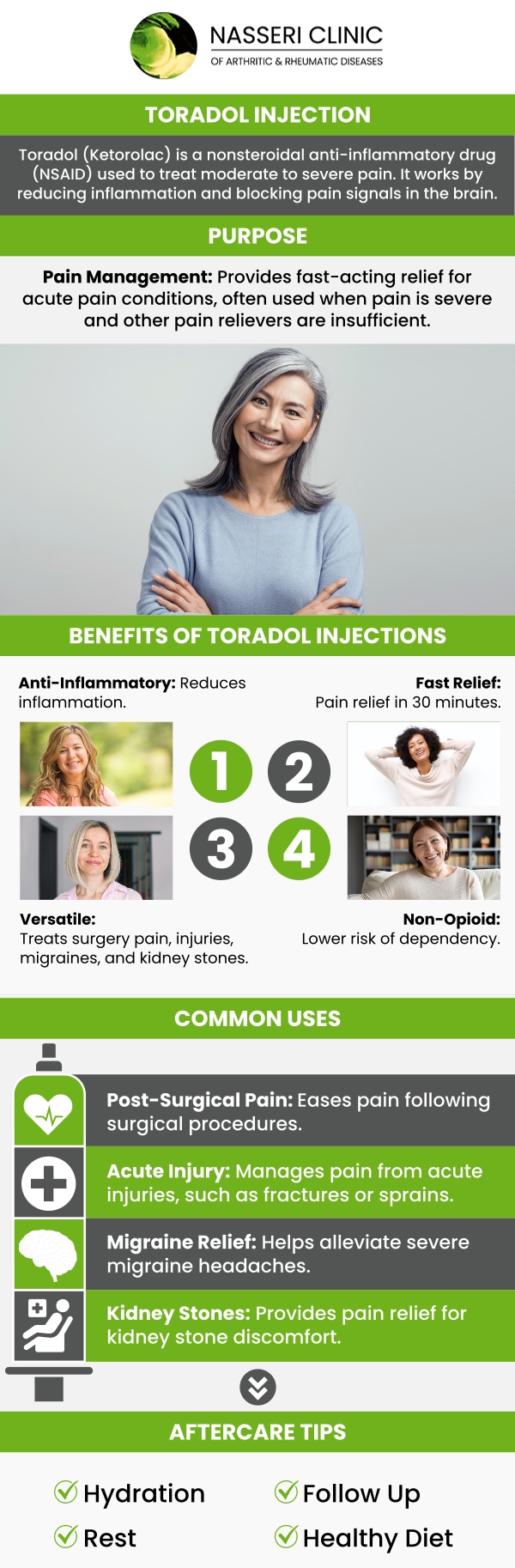
Table of Contents:
How does Toradol work to reduce joint pain and inflammation?
What types of severe joint pain may be managed with Toradol?
Why may Toradol be considered for short-term pain management?
Can Toradol help during a sudden arthritis flare-up?
How does Dr. Nasser Nasseri, MD, determine if Toradol is appropriate for joint and severe pain management?
At the Nasseri Clinic of Arthritic and Rheumatic Diseases, managing joint pain and inflammation is a key part of helping our patients achieve better quality of life. One of the medications we may use in certain cases is Toradol (ketorolac), a nonsteroidal anti-inflammatory drug (NSAID). Toradol is particularly effective for short-term relief of moderate to severe pain, especially when inflammation is a significant contributor to a patient’s discomfort—such as in acute flare-ups of arthritis or other rheumatic conditions.
Toradol works by blocking specific enzymes (COX-1 and COX-2) involved in the production of prostaglandins, which are chemicals in the body that promote inflammation and pain. By reducing prostaglandin levels, Toradol helps decrease swelling and provides effective pain relief for patients experiencing joint pain due to inflammatory arthritis or related rheumatic diseases.
Because Toradol can also reduce protective prostaglandins in the stomach and kidneys, our clinic follows guidelines that recommend it only for short-term use. This helps minimize potential side effects and ensures the safest treatment possible for our patients managing arthritis and other rheumatic conditions.
At Nasseri Clinic of Arthritic and Rheumatic Diseases, our commitment is to provide effective, evidence-based care for patients experiencing joint pain due to various rheumatic and arthritic conditions. One of the medications we may consider for short-term pain relief in select cases is Toradol (generic name: ketorolac), a potent nonsteroidal anti-inflammatory drug (NSAID).
Toradol is typically reserved for the short-term management of moderate to severe pain, particularly when rapid relief is needed and other pain medications have proven insufficient. At our clinic, we might use Toradol in the following scenarios:
• Acute Flare-Ups of Osteoarthritis: When patients experience sudden, severe joint pain that does not respond to standard NSAIDs or analgesics.
• Rheumatoid Arthritis Exacerbations: During acute inflammatory episodes where pain and swelling are significant.
• Acute Gout Attacks: For patients presenting with intense pain and swelling in joints such as the big toe, ankle, or knee, Toradol may help control symptoms.
• Post-Traumatic Joint Pain: After injuries or procedures (such as arthroscopy), short-term use of Toradol may help manage acute pain.
It is important for patients to understand that Toradol is not intended for chronic pain management, as prolonged use can increase the risk of gastrointestinal, kidney, and cardiovascular side effects. At Nasseri Clinic, our rheumatology specialists strictly limit its use to the shortest duration necessary—typically not exceeding five days—and only when clinically appropriate.
Our providers carefully evaluate each patient’s overall health, medical history, and specific pain management needs before prescribing Toradol. We are dedicated to balancing effective pain relief with patient safety, using Toradol only when the potential benefits outweigh the risks.
At Nasseri Clinic of Arthritic and Rheumatic Diseases, we prioritize safe and effective pain management for our patients living with various forms of arthritis and rheumatic conditions. Toradol, known generically as ketorolac, is a nonsteroidal anti-inflammatory drug (NSAID) that our clinicians may consider for short-term relief of moderate to severe pain associated with acute flare-ups, certain procedures, or injuries related to rheumatic diseases.
Unlike opioid medications, Toradol does not cause sedation or carry a significant risk of dependence, making it a safer alternative for patients with complex medical histories. Toradol works by blocking the production of prostaglandins—chemicals in the body that cause inflammation and pain—making it particularly useful for acute inflammatory episodes seen in conditions such as gout, pseudogout, or severe osteoarthritis flares.
Due to its potential side effects, including gastrointestinal bleeding, kidney dysfunction, and cardiovascular risks, Toradol is reserved for short-term use—typically not exceeding five days. Its rapid onset of action and availability in both injectable and oral forms make it a practical option for acute pain situations where non-opioid alternatives are preferred, such as after joint injections, aspiration procedures, or for managing pain during acute inflammatory attacks.
At Nasseri Clinic, our specialists carefully evaluate each patient’s medical history, concurrent medications, and specific rheumatologic conditions to determine if Toradol is an appropriate choice. We are committed to using the most effective and safe pain management strategies as part of your comprehensive arthritis and rheumatic disease care plan.
At the Nasseri Clinic of Arthritic and Rheumatic Diseases, we understand that patients living with arthritis and other rheumatic conditions may occasionally experience sudden and severe flare-ups, characterized by intense joint pain, swelling, and stiffness. During these acute episodes, rapid and effective pain management is essential to help you regain comfort and function.
Toradol (ketorolac) is a nonsteroidal anti-inflammatory drug (NSAID) that may be considered for the short-term management of moderate to severe pain associated with these flares. Toradol works by reducing inflammation and blocking the production of chemicals in the body that cause pain and swelling. It is often administered as an injection or in pill form, allowing for a relatively quick onset of action compared to some other oral NSAIDs.
At our clinic, Toradol may sometimes be used to provide rapid relief during an arthritis flare-up, under close medical supervision. However, due to the potential for side effects—such as gastrointestinal bleeding, kidney problems, and increased risk of cardiovascular events—Toradol is typically prescribed for only a short duration, generally not exceeding five days.
It is important to note that while Toradol can help alleviate the pain and inflammation of an acute arthritis flare, it does not address the underlying cause of arthritis or prevent future flares. It may not be appropriate for everyone, especially those with a history of ulcers, kidney disease, or bleeding disorders.
At the Nasseri Clinic of Arthritic and Rheumatic Diseases, Dr. Nasser Nasseri, MD, specializes in the evaluation and management of joint pain and other musculoskeletal symptoms commonly associated with arthritis and rheumatic disorders. When considering the use of Toradol (ketorolac)—a nonsteroidal anti-inflammatory drug (NSAID)—for pain management, Dr. Nasseri takes a personalized, evidence-based approach tailored to each patient’s unique rheumatologic profile.
Dr. Nasseri begins by conducting a comprehensive assessment of the patient’s medical history, the specific nature of their joint or musculoskeletal pain, and any underlying rheumatic diseases such as rheumatoid arthritis, osteoarthritis, gout, or systemic lupus erythematosus. He carefully differentiates whether the pain is primarily inflammatory, mechanical, or related to neuropathic processes, as this determination is critical in choosing the most effective treatment. Toradol may be considered for acute, moderate-to-severe pain episodes, especially when inflammation is a major component—for example, during acute arthritis flares or after certain rheumatologic procedures.
Given the complex needs of patients with rheumatic diseases, Dr. Nasseri thoroughly reviews each patient’s overall health, with particular attention to gastrointestinal, renal, and cardiovascular risks, as these patients may be more susceptible to NSAID-related complications. He also checks for any history of NSAID allergies or previous adverse events, and carefully evaluates the patient’s current medications to avoid potential interactions, especially with anticoagulants, corticosteroids, or other NSAIDs frequently used in rheumatology.
Before initiating Toradol, Dr. Nasseri educates the patient about the benefits and risks, emphasizing that Toradol is intended for short-term pain control (generally up to five days), to reduce the risk of serious side effects such as gastrointestinal bleeding or renal impairment. He selects the most appropriate dosage and route of administration—oral, intramuscular, or intravenous—based on the clinical scenario, such as acute gouty arthritis or post-procedural pain following joint aspiration or injection.
Throughout treatment, the Nasseri Clinic maintains vigilant monitoring for adverse effects or complications, ensuring patient safety while aiming for optimal pain relief. If Toradol is not suitable, or if it fails to provide adequate benefit, Dr. Nasseri works with each patient to develop alternative, individualized pain management strategies, which may include other medications, physical therapy, or interventional procedures, all within the context of comprehensive rheumatologic care. For more information, contact us or book an appointment online. We are conveniently located at 700 Geipe Rd, Suite 200B, Catonsville, MD 21228. We serve patients from Catonsville MD, Hebbville MD, Woodlawn MD, Arbutus MD, Ellicott City MD, and surrounding areas.
Check Out Our 5 Star Reviews


Additional Services You May Need

Additional Services You May Need
▸ Arthritis Care
▸ Infusion Therapy
▸ Lab Services
▸ Radiology
▸ NCARD NRACE
▸ BioFlex Laser Therapy
▸ Ultrasound Guided Injection
▸ Myer’s Cocktail Infusion
▸ Rheumatology
▸ Myositis
▸ Osteoporosis
▸ Saphnelo Infusion
▸ Injection Treatments
▸ Intravenous Immunoglobulin Therapy
▸ Fibromyalgia
▸ Infusion Therapy for Gout
▸ Inflammatory Eye Disease
▸ Inflammatory Skin Disease
▸ Vasculitis
▸ Lupus
▸ Toradol Injections
▸ Platelet-Rich Plasma (PRP)


 Send Text
 How May I Help You?