

How Long Does It Take for Toradol to Work After an Injection in Glen Burnie, MD?
When dealing with acute pain, waiting for medication to kick in can be agonizing. Fortunately, patients receiving a Toradol injection at the Nasseri Clinic of Arthritic & Rheumatic Diseases in Glen Burnie, MD, typically experience rapid relief. Under the guidance of Dr. Nasser Nasseri, MD, you can generally expect this powerful anti-inflammatory medication to start working within just 15 to 30 minutes. For more information, contact us or request an appointment online. We are located at 203 Hospital Dr, Suite 300B, Glen Burnie, MD 21061.
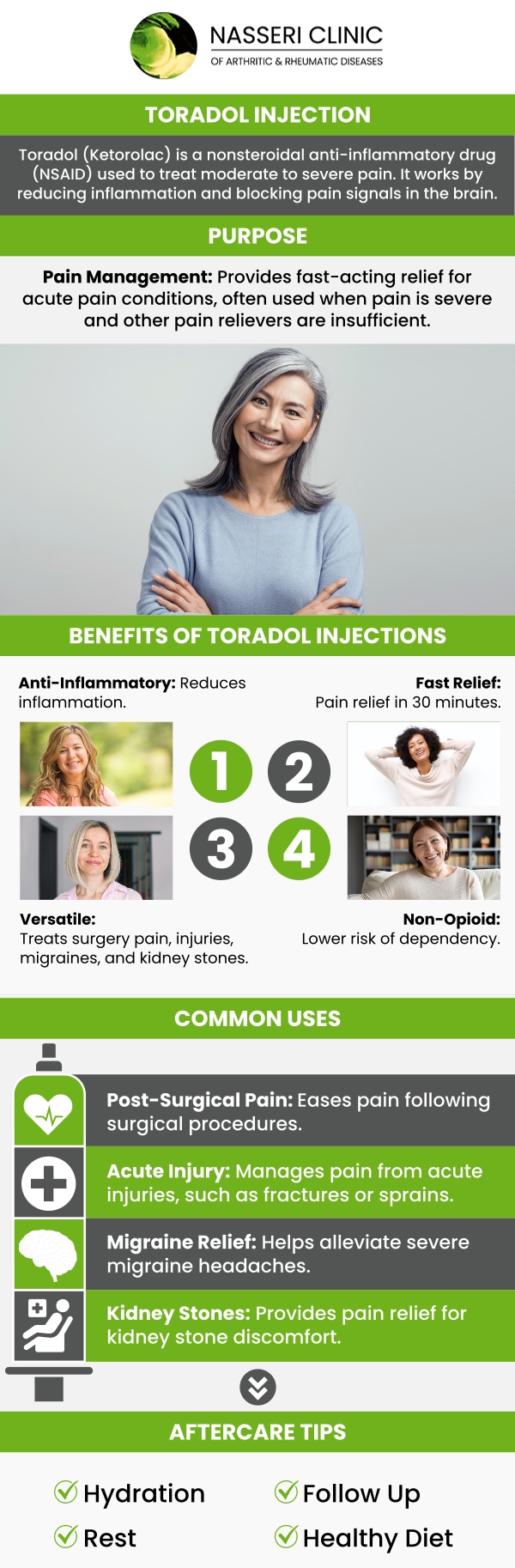
Table of Contents:
When can patients typically begin noticing relief after a Toradol injection?
What factors can influence how quickly Toradol begins working?
Does the severity of pain affect how quickly Toradol provides relief?
What happens if pain does not improve as expected after a Toradol injection?
How does Dr. Nasser Nasseri, MD, monitor a patient’s response after a Toradol injection?
At Nasseri Clinic of Arthritic and Rheumatic Diseases, Toradol (ketorolac) injections are sometimes used as part of the management plan for acute joint pain or severe inflammation related to arthritis and other rheumatic conditions. Most patients notice pain relief relatively quickly after receiving a Toradol injection—typically within 30 to 60 minutes. The medication reaches its peak effect, offering maximum pain relief, within about two to three hours. Relief often lasts for four to six hours, though this can vary based on individual factors such as your metabolism, the severity of your pain, and the specific rheumatic condition being treated.
If you receive a Toradol injection at our clinic and do not experience noticeable improvement within an hour—or if your pain worsens—please let your Nasseri Clinic provider know promptly. Our team is dedicated to ensuring your comfort and adjusting your treatment plan as needed for optimal relief from arthritis and rheumatic disease symptoms.
At Nasseri Clinic of Arthritic and Rheumatic Diseases, we often use medications like Toradol (ketorolac) to help manage acute pain associated with arthritis, gout flares, and other rheumatic conditions. The speed at which Toradol takes effect can vary based on several important factors relevant to our patients.
• Method of Administration:
Toradol can be administered as an oral tablet, an intramuscular injection, or an intravenous injection. In our clinic, injectable forms are sometimes used for acute, severe pain because they generally provide relief more rapidly—often within 30 to 60 minutes—compared to oral tablets, which may take a bit longer. This is particularly beneficial for patients experiencing sudden joint pain or severe inflammatory episodes.
• Individual Patient Factors:
Each patient’s response to Toradol can differ. Age, body weight, and metabolic rate play a role in how quickly the medication takes effect. Additionally, since many patients with rheumatic diseases may have underlying kidney or liver concerns, these organs’ function is carefully considered before prescribing Toradol, as impaired kidney or liver function can delay the onset or prolong the medication’s effects.
• Other Considerations in Rheumatology:
Many patients at our clinic take multiple medications for their arthritis or autoimmune conditions. Some of these medications—such as disease-modifying antirheumatic drugs (DMARDs) or corticosteroids—can interact with Toradol, affecting how quickly it works or increasing the risk of side effects. Furthermore, the presence of gastrointestinal conditions, which are not uncommon in patients with chronic inflammatory diseases, may influence absorption if Toradol is taken orally.
• Food and Absorption:
Taking Toradol with food may slow its absorption when used in tablet form. For those with sensitive stomachs or gastrointestinal issues, we may adjust the timing or method of administration accordingly.
• What to Expect:
On average, most patients treated at the Nasseri Clinic find that pain relief begins within an hour when Toradol is administered by injection, while oral forms require more time. The exact timing can vary based on individual health, the severity of the pain, and other ongoing treatments.
At the Nasseri Clinic of Arthritic and Rheumatic Diseases, we understand that effective pain management is a crucial part of living well with arthritis and rheumatic conditions. One medication we may use in specific circumstances is Toradol (ketorolac), a nonsteroidal anti-inflammatory drug (NSAID).
Toradol typically begins to relieve pain within 30 to 60 minutes after administration, whether it is given orally or by injection. While the severity of pain may influence how quickly you feel relief, it does not change how fast the medication actually starts working in your body. For example, patients experiencing intense joint pain or rheumatic flare-ups might notice a more dramatic improvement when the medication takes effect. In contrast, those with milder symptoms may perceive the changes as more gradual.
The actual speed at which Toradol acts is generally consistent and depends more on factors such as the route of administration, your individual metabolism, and your overall health status. It’s important to note that Toradol is usually used for short-term pain management and may not be suitable for long-term treatment of chronic arthritic or rheumatic pain.
If pain does not improve as expected after a Toradol (ketorolac) injection, it is important to reassess the situation carefully—especially in the context of arthritic and rheumatic diseases. At the Nasseri Clinic of Arthritic and Rheumatic Diseases, Toradol may be used as a short-term option for managing moderate to severe pain associated with conditions such as rheumatoid arthritis, osteoarthritis, gout, or other inflammatory disorders. Typically, patients should experience some pain relief within 30 to 60 minutes after Toradol is administered.
If pain persists or remains severe, several factors may be involved. First, the underlying rheumatic condition may be more active or complex than initially believed, and may not respond sufficiently to NSAIDs like Toradol alone. For example, severe joint inflammation, acute gout flares, or complications such as infection in the joint (septic arthritis) may require different or additional treatments, such as corticosteroids, disease-modifying antirheumatic drugs (DMARDs), or even urgent interventions.
Second, the dose or method of administration may need adjustment based on your individual health profile, including your body weight, kidney function, and overall disease activity. Some patients metabolize medications differently, which can alter how effective Toradol is for pain relief.
Persistent pain after a Toradol injection may also indicate the need for a more comprehensive pain management plan. This could involve alternative medications, physical therapy, or targeted treatments such as joint injections. Inflammatory or structural changes in joints, worsening of the underlying disease, or complications such as bleeding or tissue damage are also possible and require prompt medical attention.
If you are a patient at the Nasseri Clinic and your pain does not improve as expected after a Toradol injection, it is essential to notify your healthcare provider promptly. Our team may recommend a re-evaluation, including a physical examination and possibly additional laboratory or imaging tests, to determine the next steps. Delaying further assessment or attempting to self-medicate can lead to complications, especially in patients with chronic arthritic and rheumatic conditions.
At the Nasseri Clinic of Arthritic and Rheumatic Diseases, Dr. Nasser Nasseri, MD, ensures the highest standard of care when administering Toradol (ketorolac) injections for patients experiencing acute musculoskeletal or joint pain related to arthritis and other rheumatic conditions. Following a Toradol injection, Dr. Nasseri and his team closely monitor each patient for any immediate allergic reactions, such as swelling, rash, or difficulty breathing—important considerations for individuals with complex autoimmune or inflammatory diseases.
To assess the effectiveness of pain management, Dr. Nasseri evaluates changes in the patient’s pain levels and joint comfort, typically within 30 to 60 minutes after administration. This is particularly important for rheumatology patients, as rapid and effective pain relief can significantly improve mobility and quality of life.
The clinic team also carefully monitors vital signs, including blood pressure and heart rate, as patients with rheumatic diseases may be at higher risk for cardiovascular complications. Dr. Nasseri reviews each patient’s medical history and current medications to minimize the risk of gastrointestinal side effects, such as abdominal pain or bleeding, which can be more common in patients taking other anti-inflammatory medications or corticosteroids.
If extended Toradol therapy is required, Dr. Nasseri may order laboratory tests to monitor kidney function and blood counts, ensuring that the treatment remains safe and effective for each individual patient. This comprehensive approach reflects the clinic’s commitment to personalized, patient-centered care for those living with arthritis and other rheumatic diseases. For more information, contact us or request an appointment online. We are located at 203 Hospital Dr, Suite 300B, Glen Burnie, MD 21061. We serve patients from Glen Burnie MD, Pasadena MD, Jacobsville MD, Ferndale MD, Severn MD, and surrounding areas.
Check Out Our 5 Star Reviews


Additional Services You May Need

Additional Services You May Need
▸ Arthritis Care
▸ Infusion Therapy
▸ Lab Services
▸ Radiology
▸ NCARD NRACE
▸ BioFlex Laser Therapy
▸ Ultrasound Guided Injection
▸ Myer’s Cocktail Infusion
▸ Rheumatology
▸ Myositis
▸ Osteoporosis
▸ Saphnelo Infusion
▸ Injection Treatments
▸ Intravenous Immunoglobulin Therapy
▸ Fibromyalgia
▸ Infusion Therapy for Gout
▸ Inflammatory Eye Disease
▸ Inflammatory Skin Disease
▸ Vasculitis
▸ Lupus
▸ Toradol Injections
▸ Platelet-Rich Plasma (PRP)


 Send Text
 How May I Help You?